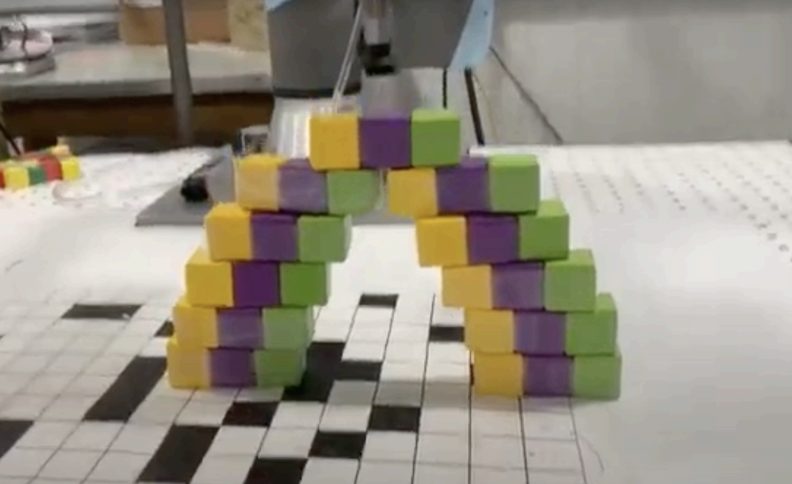
01 Overview
Each "stick" is three cube blocks — a purple center flanked by yellow (left) and green (right). The system detects the markers, computes each stick's orientation, rotates and places it via inverse kinematics, and repeats until two five-level leaning towers connect at the top into a six-level bridge. The pipeline reuses ROS nodes, forward and inverse kinematics, and a marker-detection module built up across the lab series.
02 Orientation from marker geometry
Rather than trust a single marker, I compute the stick's yaw with a three-step fallback for robustness against missed detections:
- Take arcsin of the purple→yellow vector when they sit within the expected 20–28 mm spacing;
- fall back to the purple→green vector if yellow is missing;
- fall back to green→yellow (44–52 mm) if the center is occluded — otherwise assume 0°.
03 Rotation without hitting joint limits
Joint 6 only spans −170° to 170°, so a naïve rotation can run into a hard
limit and fault. I map the required turn to its shortest equivalent with
minAngle = (target − start + 180) mod 360 − 180, then split it
— picking the block at −minAngle/2 and placing it at
+minAngle/2 (plus a 45° workspace offset) — so the wrist never
leaves its safe range. To protect the growing tower, motions approach
top-down via waypoints 5 cm above the target, and the penultimate
block slides in diagonally so it doesn't knock the structure over.
04 Making it physically stand
The overhang between layers follows the classic Tower of Lire (book-stacking) series. The theoretical offsets leave almost no error margin, so I hand-tuned a compromise set — slightly more overhang at the very top to seat the connecting block, slightly less below for stability — and built the target array top-down from a 150 mm peak before reversing it to stack bottom-up.
05 Results & limits
Against a theoretical span of ~246 mm the bridge reached 232 mm. The main error sources were camera calibration — a homography that assumes a fixed table height and ignores radial distortion — and a limited workspace that occasionally made the farthest block unreachable. I scoped the fixes too: a RANSAC slope estimate to reject marker outliers, and an "observation zone" to re-measure orientation before final placement.